
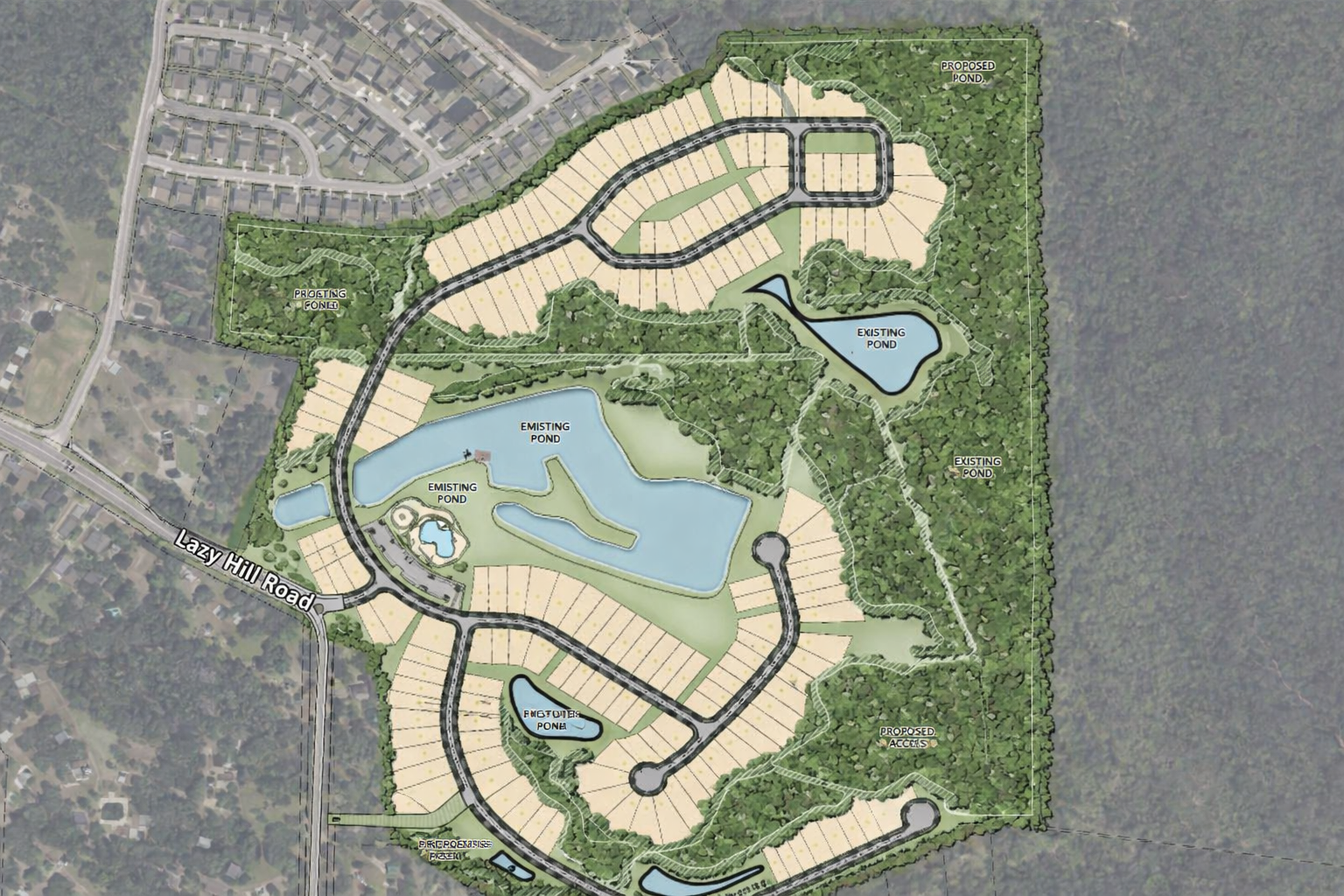
BERKELEY COUNTY, S.C. — A proposed subdivision with 191 single‑family lots averaging 7,987 square feet along Lazy Hill Road is testing how Berkeley County manages rapid growth while preserving its rural character and protecting property rights.
After first advancing through the April 13 Berkeley County Council meeting, the proposal hit a major pause April 27 when council members voted to postpone a decision on lifting the county’s large‑scale development moratorium, sending the developer back to revise the plan.
The proposed Juniper Grove subdivision by Lennar Homes would be planned across roughly 142 acres and bring new single‑family housing to the area. A traffic analysis tied to the proposal estimates roughly 1,839 daily trips along Lazy Hill Road, intensifying concerns among nearby residents.

A project rooted in family history
For property owner Jason Dangerfield, whose family has lived on the land Lennar hopes to develop, the debate extends beyond growth. It’s about guiding a piece of family history through change.
“I own and live at 271 Lazy Hill Road with my wife and daughter,” Dangerfield said. “My connection to this property goes all the way back to the beginning of my life. I first lived here when I was born in 1975. We lived in a trailer on the property until I was about five years old.”
Even after leaving as a child, he said the land remained central to his life.
“Even when I was stationed with the Navy in Beaufort as a young adult, Lazy Hill Road stayed a big part of my life,” he said. “We still came here for family, hunting, projects, visiting, working on things, and helping take care of the property.”
In the years that followed, Dangerfield took on a more active role in caring for the land and his family.
“Around 2008, I started taking a more active role in helping my grandparents and looking after the property,” he said. “About 10 years ago, I started spending most of my time here while helping care for my grandparents.”
His grandfather died in 2022 at more than 100 years old. His grandmother passed in 2024 at 97.
“They lived long lives connected to this property,” he said. “Being here with them is a big part of why this place means so much to me.”
Dangerfield said the land’s significance goes beyond acreage.
“When I talk about this land, I am not talking about it like it is just a piece of property or an investment,” he said. “I am talking about my home, my family’s home, and a place that has been part of my life since I was born.”

He said his family’s roots in the area stretch back to the mid-1800s, with generations living, working and building on the same land.
“This is not just a piece of property on a map to us,” he said. “It is where generations of our family lived, worked, struggled, celebrated, and passed down stories.”
At the same time, Dangerfield said the area around Lazy Hill Road has already undergone decades of transformation.
“My earliest memories are of a country road with only a few houses on it,” he said. “Today, it is lined with homes, mobile homes, and neighborhoods. By my rough count, there are roughly 650 homes within about a mile of us now.”
“Growth did not start with this proposal,” he added. “Growth has been moving toward this area for a long time… we are country people, but the reality is we are not really in the country anymore.”
He acknowledged that development would bring real impacts.
“Any real change is going to affect daily life in some way,” he said. “The most obvious thing would be more cars on the road. I understand why traffic is one of the first concerns people bring up.”
But he said the conversation should go beyond a single number.
“The bigger issue is not just one number on a concept plan,” he said. “It is what happens to this property as it moves into its next chapter after being tied to one family for generations.”
Dangerfield said his family spent years weighing options before moving forward.
“I have been approached by potential development partners for more than 15 years,” he said. “I had discussions with several groups… conservation interests, developers, private individuals.”
Ultimately, he chose to partner with Lennar.
“Their experience, resources, and technical ability seemed best aligned with trying to move a project like this through a responsible planning and review process,” he said.
He emphasized the decision was not driven solely by profit.
“The biggest misconception is that this decision was quick, careless, or only about money. It was not,” he said. “This was a long family process. Some conversations were emotional. Some were difficult.”
READ MORE l Proposed Subdivision Near Rural Macedonia Has Some Residents Concerned

Dangerfield said he views the proposal as a starting point — not a final outcome.
“The 191-home number is part of a beginning concept. It is not the final story of the property,” he said. “Whatever the final outcome is, it should be shaped by facts, planning, engineering and continued discussion.”
He also pointed to one unexpected benefit of the process: increased attention to long-standing issues.
“Drainage has been one of the issues people have raised,” he said. “Those issues did not begin with this proposal… but this process has helped bring more attention to them.”
Ultimately, he said his goal is to guide the land responsibly into its next phase.
“For earlier generations, stewardship meant farming and holding the land together,” he said. “For my generation, stewardship may mean guiding the land through change in a way that respects the past but deals honestly with the present.”
He added: “My hope is that whatever comes next respects the history of the land and gives other families a chance to build lives there too.”
READ MORE l Officials: Developers Withdraw Application for Gippy Annexation
April 13: Committee advances proposal, but concerns emerge
The proposal first came before Berkeley County’s land use committee on April 13, where it narrowly passed in a 3-2 vote to recommend lifting the moratorium.
Committee members emphasized that lifting the moratorium would not approve the project outright, but would allow it to move forward for further study and negotiation.
Chairman Phillip Obie explained the purpose of the process.
“The moratorium gives council and the residents an opportunity to hear from the developer first, so we can hear input from residents and try to incorporate it into the development,” he said.
During that meeting, Dangerfield acknowledged the project would bring change.
“This project will add traffic. I’m not pretending otherwise,” he said. “That is why more studies are needed.”
He pointed to early design elements, including a proposed traffic circle, and said stormwater concerns should be evaluated through engineering rather than speculation.
“I am not asking anybody to ignore issues. I am asking for this proposal to move to a point where those concerns can be studied, measured and evaluated with facts,” he said.
Some council members, however, raised significant concerns about density.
Supervisor Johnny Cribb noted that under current zoning, roughly 130 homes could be built on the property “by right,” suggesting the proposed 191 homes exceeded what many would consider compatible.
“If you come in with a number bigger than 50% of what is allowed by right, the response is entirely expected,” Cribb said.
He urged the developer to align more closely with existing lot sizes and to add buffers.
“Why not build what’s allowed and increase the buffers where the neighbors can’t see each other?” he said.
Committee Member Steve Davis opposed the request, questioning consistency in council decisions.
“In 2021, a development of 65 homes could not proceed further,” Davis said. “What has changed that a much larger development is being considered?”
Chairman Obie also voiced skepticism, citing ongoing complaints from residents across the county about traffic, drainage and quality of life.
“You could go through the entire process, and the traffic study doesn’t show that you need a light,” Obie said. “But residents are telling you they can’t even get out of their driveway.”
Despite those concerns, the committee voted to recommend lifting the moratorium.
April 27: Full council debate intensifies
By April 27, the debate had grown more intense — both among council members and within the community.
Councilman Marshall West framed the issue as a choice about how growth is managed.
“This isn’t a vote against or for development,” West said. “It is a discussion about how growth is going to happen in Berkeley County.”
He warned that rejecting the request could lead to development under existing zoning with fewer safeguards.
“If this project were to move forward under its current zoning, the developer would meet every requirement, and that’s it,” West said. “There’s no opportunity for us to reduce density or increase boundaries or setbacks.”

West urged the developer to come back with a significantly revised plan.
“To the applicant: I think you’ve heard tonight that 191 homes are unacceptable. No one here wants that. They don’t want it. I don’t want it. It’s unacceptable.”
Councilman Steve Davis pushed back strongly.
“I have traveled through Lazy Hill, and that is a beautiful area. I don’t have any animosity toward your efforts, but there comes a time when we must stand up,” Davis said.
“Why would county staff and resources be used to help accommodate a process that should be funded by the developer?” he added. “I’ve been on county council for 24 years. Developers, they build, and they disappear. They have no concerns about the true character of a community.”
Supervisor Johnny Cribb acknowledged the intensity of the debate and urged residents to remain engaged.

“That was spirited. It shows how sensitive the subject is,” he said.
He also cautioned that rejecting the proposal outright could have unintended consequences.
“Doing nothing guarantees that it’ll be built one of two ways,” Cribb said. “There’ll be schools there, or there’ll be a Flex-1 neighborhood there.”
Ultimately, council voted unanimously to postpone the request, giving the developer time to revise the proposal.
Residents: ‘We are full’
In materials submitted to Berkeley County, Lennar describes the project as a thoughtfully planned development that aims to protect natural resources, preserve key wetland areas, and include private amenities such as trails and a community center, positioning it as a balanced and responsible approach to growth.
But some vocal residents say their experience and concerns tell a different story. They argue that the proposal represents a breaking point after years of growth and a fear that approving this project could set a precedent for even more.
Peggy Gallagher described Lazy Hill Road as already overwhelmed.
“Lazy Hill Road has turned into a cut-through. The speed limit is consistently ignored,” she said. “The new homes will create a huge traffic jam. Lennar made it very clear that they have no intentions of doing anything to Lazy Hill Road to improve it.”
Janet Jones, who has lived directly across from the proposed site for decades, framed the issue not just as a single development, but as a long-term turning point for the entire area.

“Both Dangerfield and Lennar are simply cashing out, and Berkeley County’s residents are left suffering the consequences,” she said.
Jones warned that lifting the moratorium could have ripple effects beyond the current proposal.
“A vote here opens the door to something bigger,” she said. “Five years ago, a rezoning proposal for the 28 acres directly behind our property was defeated. The same arguments applied then as they do now — incompatible zoning, rural character, inadequate infrastructure.”
“If this council lifts the moratorium and rezones the Dangerfield land today, it sets a new precedent for that 28-acre parcel,” she added.
For Jones, the concern is deeply personal.
“Glenn (my husband) and I chose this land and this life deliberately,” she said. “The impacts of a 191-home construction project directly across the road from us and a future 65-home development behind us are not abstract concerns. They are daily realities we would have to live with for years.”
She also emphasized that the current zoning was intentional.
“There was no mistake made when Berkeley Run was originally zoned,” she said. “The zoning was implemented deliberately to maintain the balance between ecological systems and the people who live here.”
She also argued the decision carries broader responsibility.
“Changing the zoning will not just affect us, it will disrupt environmentally sensitive areas and wildlife habitat that serve the entire surrounding community,” she said.
Other residents echoed similar concerns about growth and infrastructure.
Wendy Rolander said recent development has already pushed the area to its limits.
“This area has changed dramatically with increased traffic, flooding. We are full,” she said.
Heather Easterlin raised concerns about safety and population increases, while Sherry Segars, who has lived on nearby Deer Track Lane since the early 1990s, questioned fairness in zoning enforcement.
“How is it fair that we can not have two homes on five acres but a builder can come in and do this?” she said. “Rules should be for all.”
Caroline Yeh, who has lived in the area for decades, described the proposal as part of a broader pattern.
“It’s just an increasing pressure on an already strained system,” she said.
Brandon Parker, who owns property on Canterhill Lane and Lazy Hill Road and has lived in the area since 1989, described how dramatically the area has changed over time.
“When we moved here, it was quiet. You could see the stars at night and listen to the whippoorwills,” Parker said. “The stars are gone with all the light pollution, the whippoorwills have disappeared, and now the traffic noise in the early morning is insane.”
He said even routine travel has become more difficult.
“You could sit at the stop sign at Lazy Hill Road and Cypress Gardens and not see a car for 10 minutes,” he said. “Now it takes five minutes just to get out — and that’s before any new development.”

Parker said the proposed subdivision would only add to existing problems.
“More traffic on top of traffic — there is no positive,” he said. “Nothing like waiting in line just to go somewhere.”
Not all opposition — but calls for compromise
Not every resident rejected development outright.
Cheryl Butler, whose backyard butts up to Dangerfield’s property in the Cypress Ridge subdivision on Carolina Wren Avenue, said growth can be beneficial if done carefully.
“Growth itself isn’t inherently negative,” they said. “If done well, it can bring investment and improvements.”
But she stressed the importance of thoughtful design.
“Once this land is cleared, it cannot be undone,” they said. “Require strong drainage planning, meaningful buffers, and preservation of natural areas — not just minimum requirements, but thoughtful ones.”
She added that a clearer visual plan could help the community better understand the proposal.
A path forward uncertain
The proposal is expected to return to Berkeley County Council later this month.
Council members have made clear they expect a revised plan — one with fewer homes, larger lots, and stronger buffers to better align with the surrounding community.
For Dangerfield, the outcome represents more than a development decision.
“It is about what responsible land stewardship looks like when a family property reaches a point of transition,” he said.
For many residents, however, the stakes are equally personal, rooted in decades of life, land and identity along Lazy Hill Road.
“We are losing the beautiful nature of our county — one developer at a time,” Gallagher said.
📰Subscribe to The Berkeley Observer newsletter at this link, and get the latest local news and updates from around Berkeley County, SC delivered straight to your inbox.
📆We’ve partnered with Evnt.com to help you market your upcoming event to the masses. Listing your event costs as low as $45. Different plans/options are available. CLICK HERE to list your event today. To view events in your area, please check out our calendar.
🪦You’ve already suffered one tragedy – and paying the high cost to announce a loved one’s passing shouldn’t further add to your grief or stress as you prepare to say a final goodbye. For more details, please visit this link.